Monday, March 28, 2011

100 Years of Variable Star Observing

This year, 2011, marks the 100th anniversary of the American Association of Variable Star Observers (AAVSO). Despite its name, the AAVSO is a truly international organization, with members in just about every country. It's a fantastic example of collaboration between professional, semi-professional, and amateur astronomers.

The focus of the AAVSO is variable stars--a type of star whose brightness varies over time, usually in a cyclic pattern. Variable stars play an extremely important role in astronomy. Certain types of variable stars obey an interesting relationship, whereby the time it takes for them to complete a cycle of brightness changes--from dim, to bright, and back to dim again--is related to the amount of light they are emitting on average. This means that, if we can measure how long it takes a variable star to go through a brightness cycle, we can work out how bright the star is intrinsically. Knowing how bright the star is intrinsically, we can work out how far away it must be to appear as bright as it does to observers on Earth. Variable stars are often the only means we have to determine the distances to celestial objects.

Many variable stars are easily visible from Earth with a small telescope. A few are even visible to the naked eye. They are popular targets for amateur astronomers. Every year, the AAVSO collects more than half a million observations of variable stars from amateur astronomers around the world. They catalog these observations and make them available to everyone. Many of their results have been used by professional astronomers in scientific publications. Canadian astronomers are among the AAVSO's strongest supporters. John Percy, past president of the AAVSO and Professor Emeritus at the University of Toronto, has relied on AAVSO data for years and has been instrumental in encouraging participation in AAVSO activities.

This year, the AAVSO is celebrating 100 years of "citizen science". Among the celebratory activities is a challenge to observers the world over to observe 100 variable stars in 100 days. Some eager Canadians have already completed the challenge. Why not try to observe a few variable stars yourself? The AAVSO publishes a handy guide to help you get started.

Monday, March 21, 2011

Strange New Worlds


University of Toronto astronomy professor Ray Jayawardhana's first popular science book, Strange New Worlds: The Search for Alien Planets and Life Beyond Our Solar System is now in wide release. It's in its second week on the Canadian non-fiction best-seller list, according to Maclean's. Congratulations, Ray!

Ray's book describes some of the first concrete steps taken by astronomers to answer the age-old question, "Are we alone?" Canada enjoys a significant concentration of researchers who study exoplanets, which are planets orbiting stars other than the Sun. Although the study of solar systems other than our own has yet to turn up an alien civilization, recent results indicate that Earth-like planets are probably not extremely rare. They may even be common!

Interested in learning more about the search for exoplanets? Why not pick up a copy of Ray's book, or head to one of the many talks he'll be giving in libraries and other public places around Canada and the US over the next few months?

Wednesday, October 06, 2010

Neptune Found Not Guilty of Harassment

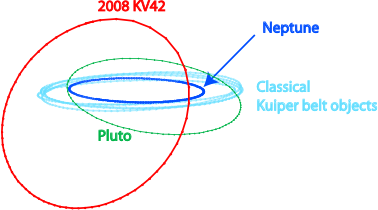
The prevailing view on the origin of the Cold Classical Kuiper Belt is that Neptune was responsible for harassing, i.e., perturbing, these objects from within the Solar System to their current position at the outer edge of the solar system. New research by a University of Victoria graduate student, Alex Parker, and his supervisor, JJ Kavelaars, at the National Research Council's Herzberg Institute of Astrophysics, has shown that is unlikely to have happened.


It turns out that binary Kuiper Belt Objects (KBOs) are quite common in the Cold Classical Kuiper Belt. We're not quite sure how these binaries form but there is no doubt they are there. Well, the simulations run by Parker and Kavelaars showed conclusively that if Neptune was responsible for moving the objects to their current position, all of the binaries KBOs would have been destroyed in the process. This will cause astronomers to rethink their ideas on how the Kuiper Belt and the rest of our Solar system was formed.

And we are still no closer to understanding how the binary Kuiper Belt objects are formed

More information

Thursday, September 16, 2010

Canadian Astronomer Wins Communication Award

Communicating science to the public is part of the job of being a scientist, especially if that scientist is being funded by taxpayer dollars. Now not all scientists can (or in some cases, should) be talking with the public, but it is important to recognize those who do publicize science, and in particular those who do it well.

Professor Doug Welch of McMaster University has been awarded the 2010 of the McNeil Medal for science communication and promotion by the Royal Society of Canada. This medal is awarded to a person who has demonstrated outstanding ability to promote and communicate science to students and the public within Canada.

More information

Thursday, July 22, 2010

Buckyballs in space

Canadian astronomer Jan Cami (U. of Western Ontario) used the Spitzer telescope to identify the heaviest molecules ever detected in space. Buckyballs, officially called buckministerfullerenes after the famous architect, are composed of 60 carbon atoms arranged in the shape of a football or the geodesic dome designed by Fuller.The bucky balls were identified in the infrared spectrum of the planetary nebula Tc 1.


Scientists have been searching for buckyballs in space since soon after they were discovered in the lab in 1985. These molecules appear to be located on the carbon dust grains that form in the material ejected from the star as it forms a planetary nebula.

More information is available here.

Tuesday, June 22, 2010

Confirmation of Directly Imaged Planet

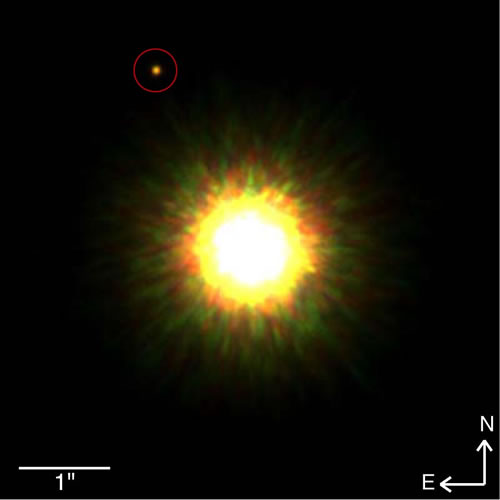
In 2008, Canadian astronomers announced that they had taken the first direct image of an exo-solar planet. As I noted in my post from 2008, previously imaged exo-solar planets orbited brown dwarfs, also known as failed stars.

While unlikely, there was still a chance that the image showed a juxtaposition of the host star and a faint background star. In order to rule this out, one needs a second observation to show that the star and the planet have move together. If it was indeed a background star, then they would be moving a different rates, and in different directions, and this would become apparent with the second observations.

The same team has now announced that a followup observation with the Gemini North telescope has confirmed that the object is definitely a planet orbiting the host star. They also obtained images at other wavelengths, which confirm the temperature and mass they derived in 2008.

The planet
around 1RXS J160929.1–210524. is 8.4 times Jupiter’s mass, and is about 1800 kelvin (2780° Fahrenheit). The planet orbits its star at 330 times the distance from Earth to the Sun.

For more information see the Gemini press release.

Thursday, June 03, 2010

Canada's Artic May Have the Best View of the Universe


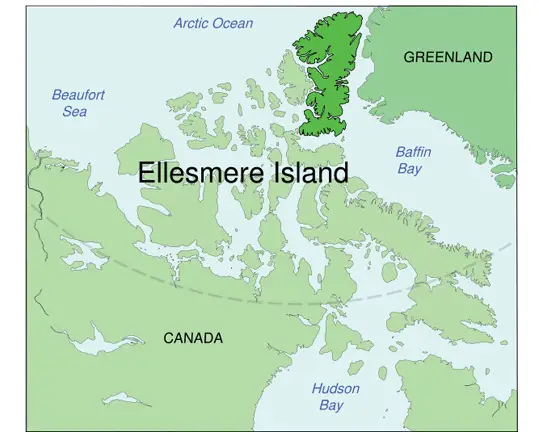
Recent studies suggest that Canada may have the best site (short of being in space) for viewing the Universe. Preliminary testing of a site located on Ellesmere Island, located far north of the Arctic Circle, show that the images of the night sky are extremely sharp. This, in addition to a low percentage of cloud cover, make this site very attractive for locating a telescope. Rob Thacker has written a nice articleLink on this research.

Saturday, May 29, 2010

International Astronomical Union Thanks Canadian Mint


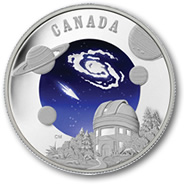
The Canadian Mint has received a Certificate of Appreciation from the International Astronomical Union (IAU). The certificate is in recognition of the Mint's production of an astronomy coin for the International Year of Astronomy (IYA). The attractive coin features an observatory surrounded by images such as a galaxy, a comet and the planet Saturn. IYA was a tremendous success in Canada with almost two million people experiencing a "Galileo moment". Visit the Canadian IYA site for more information on the events that occurred during 2009 and a summary report (will be available in early June).

Monday, February 22, 2010

Canadian Astronomers Share Prestigous Prize

The team of astronomers led by Dr. Christian Marois of the National Research Council's Herzberg Instituute of Astrophysics has won the 2009 Newcomb Cleveland Prize of the American Association for the Advancement of Science (AAAS). This award, the AAAS's oldest, recognizes the author or authors of an outstanding paper published in the journal Science.


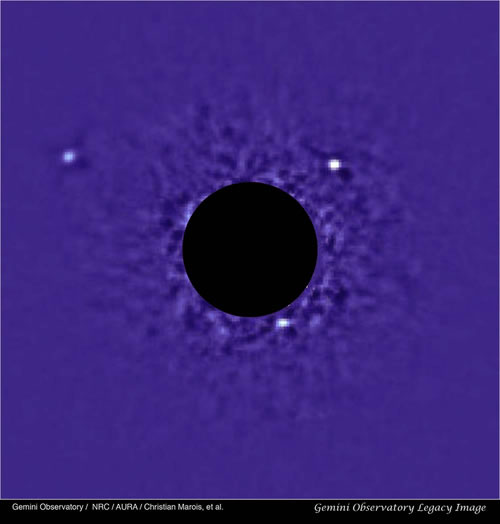
Dr. Marois' team directly imaged three planets around the star HR 8799 using the Gemini and Keck telescopes. Their series of images show the three planets orbiting the star.

While the Marois result is exciting there will be many more planet images released in the future. At Gemini, the NICI Planet Campaign is using 500 hours on Gemini South to search for planets. In the next few years even more advanced instruments will be used to search for planets around a multitude of nearby stars. The Gemini Planet Imager (GPI) and SPHERE on the VLT should start looking for planets in late 2011.

More information

Friday, February 12, 2010

Canadian Science Communicators Receive Awards

The American Institute of Physics (AIP) announced the three winning entries in the 2009 Science Communication Awards today. I was delighted to see Canadians win two of the three awards - yes that is 2/3 for Canadians! Dan Falk, based in Torontom won the Science Writing Category for his feature article "End of days: a universe in ruins. Cora Lee and Gillian Oreilly, writers based respectively in Vancouver and Toronto, Canada, have won the 2009 AIP Science Communication Award in the Children's Category for their book "The Great Number Rumble: A Story of Math in Surprising Places.

More information

Monday, September 15, 2008

Canadian astronomers take first picture of a planet around a 'normal star'


Most of the exo-solar planets that have been imaged thus far have been orbiting cool brown dwarfs, also known as failed stars. A team of Canadian astronomers, using the Gemini North telescope, have taken the first picture of a planet orbiting a normal sun-like, star. The team used Gemini's adaptive optics system, Altair, along with a near-infrared imager to capture the data.

The planet is about 8 times as massive as Jupiter and is located at a distance of 330 Astronomical Units from the star. If the star was the same age as our Sun, the planet would be much too faint to image from Earth. However, the parent star, and hence the planet, are very young. The planet is still cooling and its current temperature is about 1500C which makes the planet bright enough to image in the infrared.

One interesting question raised by this discovery is whether similar massive planets exist in our solar system. Perhaps one more Jupiter-mass planets are lurking out with the Kuiper belt objects beyond Pluto!

Thursday, March 01, 2007

Help Build an Observatory

Amateur astronomers are a very dedicated group who often share their enthusiam with the night sky with people, especially children, in their communities. The Big Sky Astronomical Society, located in Vulcan, Alberta, is aiming to build an observatory at a good dark sky site. They have a telescope, a pier, a lease on the land, and now all they need is $4000 for the materials to build a roll-off-roof observatory.
Their goal with this observatory is give children and the general public a chance to view the night sky from a dark location so they appreciate the beauty that nature gives us. You can help make this happen by visiting their donation site which is part of the GiveMeaning project. Help kids learn about the wonders of the Universe today.