Thursday, March 01, 2007

Help Build an Observatory

Amateur astronomers are a very dedicated group who often share their enthusiam with the night sky with people, especially children, in their communities. The Big Sky Astronomical Society, located in Vulcan, Alberta, is aiming to build an observatory at a good dark sky site. They have a telescope, a pier, a lease on the land, and now all they need is $4000 for the materials to build a roll-off-roof observatory.
Their goal with this observatory is give children and the general public a chance to view the night sky from a dark location so they appreciate the beauty that nature gives us. You can help make this happen by visiting their donation site which is part of the GiveMeaning project. Help kids learn about the wonders of the Universe today.

Sunday, January 28, 2007

Observatory B&B

Do you enjoy travelling? Also enjoy viewing dark, night skies? Well the Observatory B&B may be for you. The Observatory B&B is operated by Jack and Alice Newton and is located near Osoyoos, BC. Jack Newton is well-know for his known for his astrophotography and his passion for astronomy. These world-class astronomy-theme accommodations are available from mid-April to early October each year. Their B&B has been written up in a long list of magazines and newspapers.

The Newton's winter in Arizona at the Arizona Sky Village which also offers spectacular night skies to the intrepid traveller.

Thursday, January 11, 2007

Most Distant Star Clusters

Harvey Richer (UBC) and his former student, Jason Kalirai, have discovered the most distant star clusters even seen. This serendipitous discovery was made from very deep images taken with the Hubble Space telescope. The data was taken to study the very faint stars in a globular cluster NGC 6397 in the Milky Way.


A close examination showed a very distant elliptical galaxy surrounded by globular clusters. In order to determine the distance to the galaxy a spectrum was obtained with the Gemini South telescope. This spectrum showed that the globular clusters are the most distant ever studied.

More

Wednesday, January 10, 2007

New Gemini Images


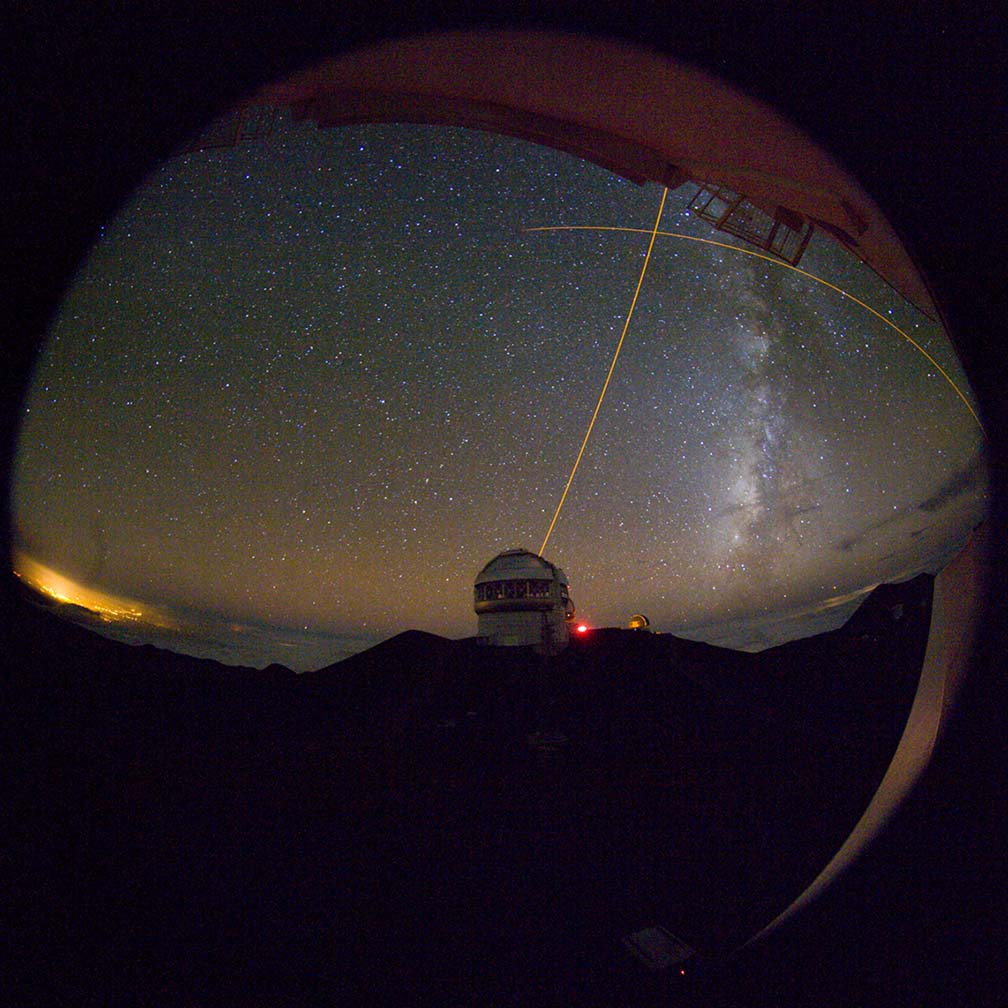
The Gemini Observatory has published a new series of spectacular images. These images were taken with a circular fisheye lens that produces unique views of the telescope and the sky above Mauna Kea. The image to the left shows the sodium lasers of Gemini and Keck that are used to generate artificial stars for their adaptive optics systems.


Friday, December 29, 2006

BLAST flies again

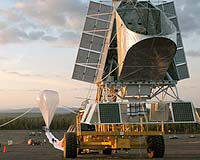
BLAST, the Balloon-borne Large-Aperture Sub-millimeter Telescope, launched from the McMurdo Research Station in Antarctica on December 21Launched from the McMurdo Research Station in Antarctica on December 21. BLAST will address some of the most important galactic and cosmological questions regarding the formation and evolution of stars, galaxies and clusters.
The Canadian role in BLAST is to design and build the gondola, pointing system and control electronics. This is an ambitious project, requiring the largest payload which can be launched in Antarctica and as fine-tuned a pointing system as has been flown on a balloon in order to take advantage of our diffraction limited optics. We are working with AMEC, who have designed the telescope and gondola.
AMEC has been involved in Canadian astronomy projects since they helped construct the Canada-France-Hawaii Telescope in the 1970s.

BLAST had a flight in 2005 when it was launched from Sweden and landed in the Canadian artic. More information on BLAST can be found on the UBC website.

Friday, October 27, 2006

Shake, Rattle and Roll

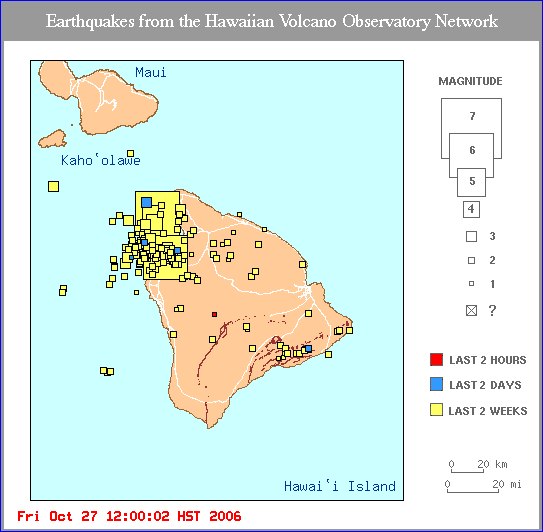
The earthquake that rumbled across the Big Island on October 15 has impacted Gemini North, Canada's largest optical telescope. All of the telescopes on Mauna Kea were offline for a short time after the earthquake, but the larger, more sophisticated telescopes including Keck, Gemini and Subaru are still recovering.

Gemini escaped without any serious problems except for its Secondary Control System (SCS). This is a sophisticated piece of electro-optics that controls the motion of Gemini's high technology secondary mirror. The secondary mirror can perform high-speed tip-tilt motion to correct for windshake and a small amount of atmospheric turbulence. The SCS also performs chopping where the mirror moves quickly back and forth between two points close separated on the sky during mid-infrared observations.

Recent tests of the SCS have demonstrated that the problem detected a few days ago is very likely due to a bad position sensor and/or associated cabling. Unfortunately these components are deeply embedded within the tip/tilt system and Gemini must remove the secondary mirror from the telescope and perform the necessary repair work in the summit lab. Given the time needed to remove the secondary from the telescope, receive new parts, install them, then mount the secondary mirror assembly back on the telescope, Gemini North will be shutdown for at least 2 more weeks. When the secondary mirror is repaired and night-time tests are possible, we still must make a variety of telescope performance tests before going back into science operations.

Thursday, October 19, 2006

Canadian Astronomers Score in Imaging Contest

Canadian astronomer Jayanne English of the University of Manitoba has won the Second NRAO astronomy image contest. Jayanne's striking image of an enormous bubble blown into the dusty gas disk of our own Milky Way galaxy used data from the Very Large Array and the Greenbank Telescope

Canadians did very well in the contest taking three out of five honourable mentions. The image contest is part of a broader NRAO effort to make radio astronomical data and images easily accessible and widely available to scientists, students, teachers, the general public, news media and science-education professionals.

Friday, September 29, 2006

Champagne Supernova in the Sky

This article is not about the Oasis song but about the discovery of a peculiar supernova. The conventional view is that supernovae of type Ia are the explosion of a white dwarf that has exceeded the so-called Chandrasekar limit. An international team of astronomers led by Canadians has discovered a possible super-Chandra supernova.

The type Ia supernova are of special interest as they are being used as standard candles to measure the expansion of the Universe. Now a team of astronomers led by a group at the University of Toronto has discovered a supernova more massive than previously believed possible. Andy Howell, lead author of the study, identified a Type Ia supernova in a distant galaxy 4 billion light years away that originated from white dwarf whose mass is far larger than any previous example. University of Oklahoma professor David Branch has dubbed this the “Champagne Supernova,” since extreme explosions that offer new insight into the inner workings of supernovae are an obvious cause for celebration.

Friday, September 15, 2006

Star Counts from the Shuttle

Most people have looked up at the dark night sky and have been amazed by the number of stars you can see. What if you were to try that from the Space Shuttle? Canadian astronaut Dr. Steve MacLean will do that during the current shuttle mission.


Dr. McLean had over 600 students do exactly this experiment this summer as part of the Star Count Project organized by NASA and the Canadian Space Agency.

Tuesday, September 05, 2006

Thirty Meter Telescope News

As I've mentioned previously, Canada is a equal (25%) partner in the Thirty Meter Telescope (TMT) Project. The TMT is the world's most ambitious optical telescope project and we can expect the first science images from the telescope in about 2015.

The TMT Project publishes monthly electronic "Newscasts" which cover various aspects of the project. The August issue covers a range of topics including science, technical and management. One article describes how the Project is undergoing a huge cost estimating exercise. The goal is to come up with an accurate cost estimate for the telescope and to have this estimate reviewed by experts later this year.

This issue contains an excellent article by Dr. Tim Davidge of Herzberg Institute of Astrophysics (HIA) in Victoria on studying stars in the Andromeda Galaxy with adaptive optics powered imaging camera on TMT. TMT will have four times the resolution of the Hubble Space telescope and will be able to image stars that are much fainter.

The cover of TIME Magazine declares "How the Stars Were Born" and the accompanying article features TMT Board member Richard Ellis. TMT will greatly enhance our understanding how stars, and galaxies, are born.

This issue of the TMT Newscast includes a Q&A with Dr. David Crampton who is the Instruments Group Leader for TMT and is also the Head of Instrumentation at HIA.


Read more...

Friday, September 01, 2006

Pluto, 1930 — 2006, RIP

While not necessarily a Canadian story I feel I must make some comments on the planet definition issue. After all, I was one of the IAU members in Prague who actually voted on the four resolutions on the definition of a planet and other Solar System bodies. There are a number of Canadian astronomers who work on Solar System bodies. The Canada France Ecliptic Plane Survey is undertaking a careful survey of Kuiper Belt Objects, of which Pluto is now recognized as the prototype.


The initial Resolution presented to IAU members was seriously flawed. There was wide agreement that something better was needed and this was voiced very vigorously in the Tuesday lunch hour discussion the last part of which is very interesting to watch. The original resolution totally ignored the dynamics of bodies in their definition. After all planets and all other Solar System objects do move!

Personally, I think after the disasterous initial proposal the process to reach the final four Resolutions was much too quick. The IAU should have tabled the issue until the next General Assembly in Rio de Janeiro and set up a more balanced Committee to go back to the drawing board.

I don't think we've heard the last of this and there is a petition of scientists who want to overturn the new IAU definition.

For everyone's information I voted YES, NO, YES, NO on Resolutions 5A, 5B, 6A, 6B.

Tuesday, August 22, 2006

Faint, Fainter, Faintest

Astronomers are always observing stars or galaxies that are faint, i.e., not very bright. This is usually because by pushing the limit we learn more about the Universe. A team of astronomers led by Harvey Richer from UBC have used the Hubble Space Telescope to observe the faintest stars ever observed, in the globular cluster NGC 6397.

Their research revealed the lowest mass stars on the main sequences in this cluster. These are the smallest stars that will burn hydrogen through fusion and live many billions of years rather than simply fading away after 1 billion years or so.

Richer and colleagues also detected a characteristic change in the color of white dwarfs in the cluster that is related to the onset of molecular hydrogen being formed in the cooling atmospheres as the white dwarfs die. With this information in hand, astronomers can learn more about the physics of low mass stars and white dwarfs and perhaps improve the estimate of the ages of these stars and the universe.