Tuesday, August 22, 2006

Faint, Fainter, Faintest

Astronomers are always observing stars or galaxies that are faint, i.e., not very bright. This is usually because by pushing the limit we learn more about the Universe. A team of astronomers led by Harvey Richer from UBC have used the Hubble Space Telescope to observe the faintest stars ever observed, in the globular cluster NGC 6397.

Their research revealed the lowest mass stars on the main sequences in this cluster. These are the smallest stars that will burn hydrogen through fusion and live many billions of years rather than simply fading away after 1 billion years or so.

Richer and colleagues also detected a characteristic change in the color of white dwarfs in the cluster that is related to the onset of molecular hydrogen being formed in the cooling atmospheres as the white dwarfs die. With this information in hand, astronomers can learn more about the physics of low mass stars and white dwarfs and perhaps improve the estimate of the ages of these stars and the universe.

Thursday, August 10, 2006

Planets Without Stars

Astronomers have always thought that objects with the mass of planets orbit stars, or failed stars, know as brown dwarfs. Now a discovery by a team led by a University of Toronto researcher, Ray Jayawardhana, has shown otherwise.

The team's discovery of a seven-Jupiter-mass companion next to a planetary mass object, only twice its mass. Both objects have masses similar to those of extra-solar giant planets, usually found in orbit around a star. Unexpectedly, these bodies appear to circle each other.

The team discovered the companion candidate in an optical image taken with the European Southern Observatory’s 3.5-meter New Technology Telescope on La Silla, Chile, and investigated it further with optical spectra and infrared images obtained with ESO’s 8.2-meter Very Large Telescope on Paranal, Chile. These followup observations confirmed that both objects are young, at the same distance, and much too cool to be stars. The existence of this wide pair poses a challenge to a popular theory which suggests that brown dwarfs and planemos are embryos ejected from multiple proto-star systems.

Wednesday, August 02, 2006

A Tale of Two Telescopes

Those familiar with sky probably know of Castor and Pollux the Gemini Twins. Well, there is another pair of Gemini twins in the Universe and those are the twin 8-meter telescopes operated by the Gemini ObservatoryGemini NorthGemini is unique in having telescopes in both the northern and southern hemispheres giving astronomers access to the complete sky.

The Gemini Observatory runs two of the world's largest telescopes, Gemini North (located on the extinct volcano Mauna Kea, on the Big Island of Hawaii) and Gemini South (located at Cerro Pachon, in the Chilan Andes). These telescopes use the latest technologies to achieve the best performance possible. The Gemini telescopes are optimized for both image quality and performance in the mid-infrared.

Image quality refers to the sharpness of the stars imaged by the telescope. The earth's atmosphere naturally blurs slightly images taken by telescopes. However, astronomers have developed a technique called adaptive optics which mostly corrects for this blurring effect.

Gemini South

Mid-infrared astronomy is very challenging. Think of it as trying to look through an optical telescope at mid-day on a snowy field which reflects all of the sunlight. The problem is that everything on the telescope is emitting at the wavelengths at which you are trying to observe. Gemini has taken great precautions to ensure that as little of the telescope emission finds its way into the camera. The two Gemini telescopes are the best performing telescopes on the planet today.

Don't worry if you are unable to visit either of the Gemini telescopes. There is a Virtual Tour available on CD for the cost of an e-mail.

Monday, July 31, 2006

Billions and Billions of Stars

One of the important measurements astronomers make is the brightness of stars. Originally this was done by eye. When astronomers started using photographic plates, special devices were used to measure the brightness of stars. Today, computers combined with powerful software are used to measure the brightness of stars, called photometry on CCD images.

Dr. Peter B. Stetson, of the National Research Council, was recently elected a Fellow of the Royal Society of Canada, the Academy of Arts, Humanities and Sciences of Canada, partly for his photometry software call DAOPHOT. DAOPHOT was developed especially to do photometry on stars which are very close together or even overlapping. Since it's initial release in 1985, DAOPHOT has been used by thousands of astronomers to measure countless billions of stars on millions of CCD images. A Google search for DAOPHOT returns over 78,000 hits. Dr. Stetson's paper describing the DAOPHOT software is the most highly cited paper in astronomy for 1987 with over 2,100 citations.

Dr. Stetson himself has applied it to the study of the ages of stars and to the determination of the age of the universe from its expansion rate. On all these topics he is considered a leading authority.

Friday, July 28, 2006

16th Kingston Theoretical Astrophysics Meeting

The 16th "Kingston" meeting was held recently in, hold your breath, Kingston. While this may seem obvious the "Kingston" series of meetings on theoretical astrophysics are not always held in Kingston. The series got its name after the location of the original "Kingston" meeting.
DickThis meeting was special as it celebrated the 65th birthday of Professor Richard Hendriksen, a preeminent theoretical researcher from Queens University. This year there were 68 attendees, with one person who made it over the pond from Leiden (Netherlands).

The Wednesday of the conference was humourously dubbed "Henriksen Fest"
and all the presenters were able to highlight contributions made by Dick to their respective fields. Jim Stone got things going with the first keynote session and did an admirable job as session chair for the morning.
Excellent presentations by Shantanu Basu, Ralph Pudritz (keynote) and Peter Martin filled up the rest of the morning. As part of a surprise for Dick Henriksen, Alan Bridle was present for the afternoon session and the banquet in the evening. The final event of the afternoon was a special lecture by Dick on when we can expect scale invariance.

The banquet was attended by over 70 people, with friends and colleagues from throughout Dick's career attending. Larry Widrow was an informal master of ceremonies and a series of roasts were gleefully given. The evening was broadly divided into Dick's career at Queen's and his involvement in the founding and running of CITA. Both Dave Hanes and Alan Bridle recounted stories of some of Dick's less well considered ideas at Queen's (spending the winter on a wooden boat on Lake Ontario being one of
them!) Peter Martin and Dick Bond then followed-up with stories from the anuls of CITA. Following some impromptu congratulatory remarks from former students and colleagues, Stephane Courteau presented the "Henriksen Love Fest 2006", a series of slides reflecting on Dick's lighter side and the evening was concluded with the presentation of a series of gifts, including a new chainsaw for Dick to wreak havoc on his land!

Although the Wednesday was the centrepiece of the conference, the other sessions was also well attended and the planetary on session on the Tuesday morning got things off to a great start. The cosmology session on Thursday was also a highlight with summaries of the new physics coming out of the Cosmic Microwave Background, as well as galaxies and galaxy surveys, being given. Perhaps the only down side to the conference was that all but one of the panel sessions evaporated as questions asked during the presentations ate into the allotted time!

Thursday, July 27, 2006

Thirty Meter Telescope News

I've mentioned the Thirty Meter Telescope (TMT) in an earlier post. Canada is a 25% partner in the TMT project, which is currently in the Design and Development Phase. The latest TMT Newscast's focus is on site-testing. Deciding where to put your telescope is extremely critical - you only get one chance to pick the right spot. Besides lots of clear skies, a good telescope site will be one with minimal atmospheric turbulence, which will allow the telescope to produce excellent images. Other factors that are important include: wind speed, height of the mountain, accessibility, available infrastructure, and impact on operating costs.

The newsletter also talks about cosmic reionization. We see the Universe as it is today because it is transparent to ultraviolet photons. Thirteen billion years ago the neutral hydrogen gas was ionized making it tranparent to these photons. How and when it happened exactly is something that we don't understand. When did this remarkable event happen? What role did the first star-forming galaxies play and how did those early systems develop to become the galaxies we see at later times? These are some of the questions researchers using the TMT and other facilities are hoping to answer.

....More

Tuesday, July 25, 2006

The Universe in a Computer

Unlike other sciences, astronomers can't go to the lab and do experiments - we have to passively observe the Universe. The increasing power of computers and the development of sophisticated computer codes have allowed numerical simulations to emerge as one of the key components of modern astrophysics. It is now possible to run an experiment on a computer and see what happens when galaxies collide, or watch the development of a proto-planetary system around a young star, or follow what happens to gas as it falls into a black hole.


Canada's Institute for Computational Astrophysics (ICU) located at Saint Mary's University is a leader in this increasingly important field. Researchers at the ICU study areas such as modeling the inner workings of stars, understanding the structure of stars by studying how they vibrate and the dynamics of our solar system.

Monday, July 24, 2006

Observing the Cold Universe

Astronomers observe the Universe over a wide range of the electromagnetic spectrum from gamma rays to x-rays to the ultraviolet visible and infrared. The JCMT views the sky in the submillimetre region of the spectrum, i.e, at wavelengths just under a millimetre. At these wavelengths, the telescope can detect objects in the dusty regions in space that would normally be obscured at visible wavelengths. Because the wavelength of radiation is related to the temperature of its source, submillimetre measurements can reveal something about cooler objects in space (-263 C), like interstellar dust.

JCMT revolutionized our understanding of the cold Universe with an innovative instrument called SCUBA. SCUBA observations have helped open up a whole new area of study – that of the evolution of early galaxies. As revolutionary as SCUBA was, later this year its successor SCUBA2 will be delivered to Hawaii. SCUBA2 will be much more sensitive than SCUBA and will be able to produce images up to 1000 times faster than SCUBA.

Canada is a member of the consortium building SCUBA2 with work being done at the University of Waterloo and the University of British Columbia among other places.

Friday, July 21, 2006

Canadian Astronomy Education

Two subject that most kids find interesting at some point are dinosaurs and astronomy. For many the interest in astronomy remains even as they move into other careers. If I want to have quiet time on a plane I know that I can't tell the person sitting next to me that I'm an astronomer.

Astronomy is part of the curriculum in all provinces. The Canadian Astronomical Society has established a very nice web site for Canadian Astronomy Education that provides resources for students, teachers, youth groups and others. The site contains information from the history of Canadian astronomy to Canadian contributions to a guide to careers in astronomy. For teachers there are lessons plans and project ideas. For students there are links for learning more about astronomy, ideas for science fair projects and the Canadian Junior Astronomer Program

Thursday, July 20, 2006

Jupiter's Giant Red Spot has a Buddy

In January 1610 Galileo used the latest technology, a new invention later named the telescope, to look at Jupiter. In doing so he changed our perception of the Universe by discovering four objects that orbited Jupiter rather than the Sun. Fifty Years later Cassini discovered the Great Red Spot on Jupiter.

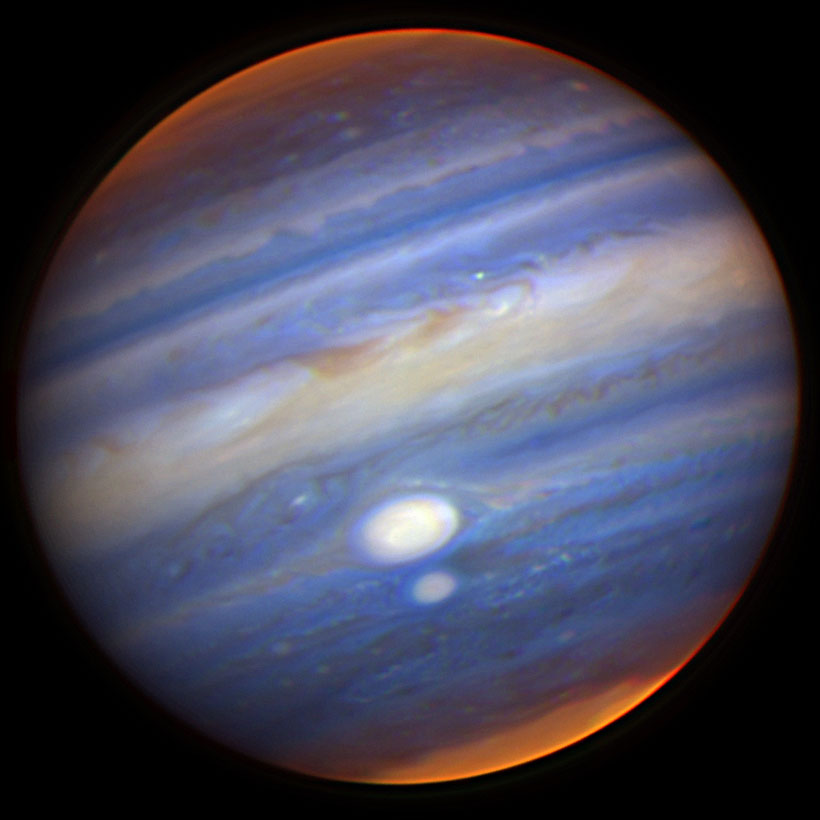
Astronomers are still studying Jupiter today, both with ground-based telescopes and with space missions such as the aptly named Galileo mission. Today the Gemini Observatory released an image of Jupiter taken with their state-of-the-art adaptive optics system, Altair. Adaptive optics corrects the distortions introduced by looking through the atmosphere and allows telescopes on the ground to perform almost as well as telescopes in space. This animation provides a brief overview of how an adaptive optics system works. [2.73 MB Quicktime Movie]. The Altair system was built by the National Research Council in Victoria.

The Gemini image shows that the Giant Red Spot now has a companion named Red Spot Junior. Both are massive storm systems that are a product of strong convection currents that violently swirl gases in that region of the planet's atmosphere - very similar to hurricanes on Earth. Read more details.

Wednesday, July 19, 2006

Understanding Dark Energy

Yesterday I mentioned that the CFHTLS was using distant supernova to study the mysterious dark energy. The Supernova Legacy Survey (SNLS), as it is referred to, will detect hundreds of supernova out to a redhift of 1. SNLS uses Type Ia supernovae as standard candles to study the acceleration of the universe. Supernovae at high redshift are very faint.

SNLS detects supernovae by comparing the current image of a patch of sky with a template image taken previously. ? A computer program studies both images looking for new stars. Can you see the SN in the image to the far left which is not in the other image?

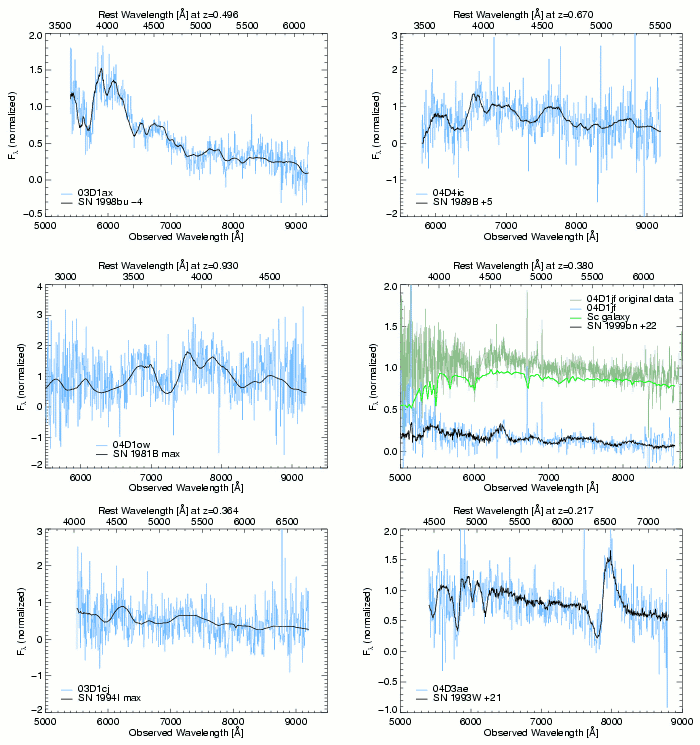
In order to use the SN to study dark energy we need to know the distance to the supernova. Since we (think) we know how bright the SN are intrinsically the measured peak brightness gives us a direct measurement of the distance. We also need to measure the reshift of the SN from a spectrum. This requires the largest optical telscopes in the world such as the 8-m Gemini. Some of the spectra from Gemini of detected SN are to the left. The measured spectra are the very squigly lines while the smoother line is the fit of a template SN spectrum.

The SNLS group published their results in late 2005 based on the first year (out of five) of SNLS data. These results already place the tightest constraints on the nature of dark energy when combined with the results from WMAP. SNLS is a good example at how astronomers are using data from several telescopes, both on the ground and in space, to tackle the challenges in understanding the Universe.

Tuesday, July 18, 2006

150 Terabytes and Growing

The instruments astronomers use today produce data at a, well, astronomical rate. We have also realized over the past 20 years or so that the digital data can be very useful for research beyond what the original investigator intended. Thus, the growing importance of data archives. One of the largest collections of astronomical data is located in Canada at the CADC. The CADC began in 1986 as one of three archive sites for the Hubble Space Telescope. It now archives data from several ground-based telescopes as well.vWhile the CADC still archives Hubble data the largest volume of data now comes from the Megacam camera at the CFHT

Megacam is a 340 Megapixel camera and each image it produces is approximately 750 Megabytes. The Canadian and French communities are undertaking very ambitious, five year research projects with Megacam, called the Canada-France-Hawaii Telescope Legacy Survey. One of the projects uses distant supernova to understand the nature of the recently discovered dark energy.